Technology
Ultra-Thin Solar Film Launches at 24% Efficiency
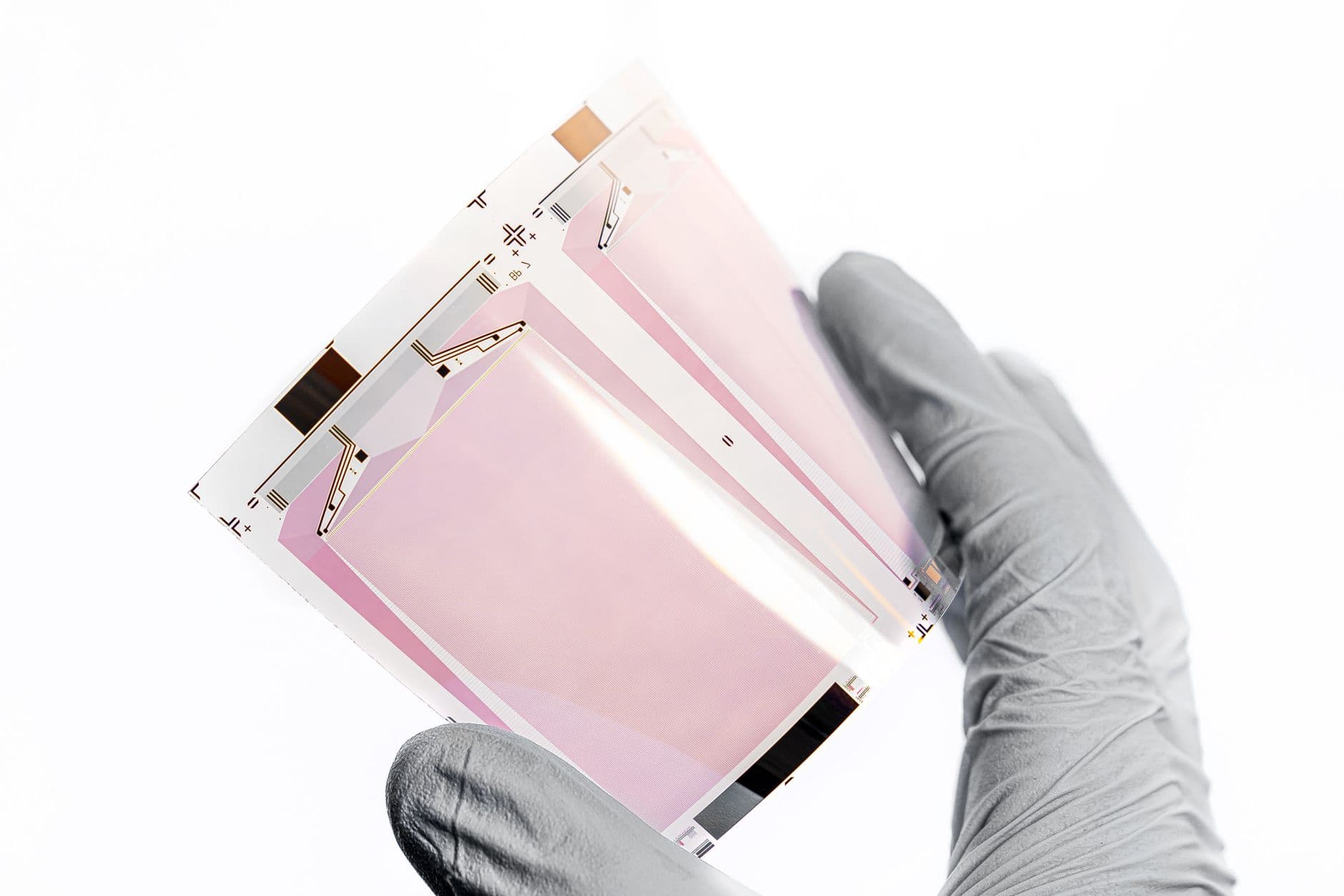
ElectroFlex debuts with 24.4% cell efficiency and 0.85 mm thickness
SolarWindow Technologies has rolled out ElectroFlex, a peel‑and‑stick solar film that is only 0.85 mm thick and delivers a certified 24.4 % conversion efficiency. The product is ready for Tier 1 OEMs in the United States and is positioned for rapid expansion into North America and Asia.
The launch was announced in a press release and covered by PV Magazine PV Magazine. SolarWindow describes ElectroFlex as a “peel‑and‑stick” solution that can be applied to flat or curved surfaces without frames, glass, or heavy mounting structures.
How the five‑layer laminate generates power
ElectroFlex consists of a five‑layer composite laminate: a 0.10 mm front encapsulant, 0.16 mm high‑efficiency interdigitated back‑contact (IBC) cells, a 0.04 mm copper backing, a 0.30 mm composite laminate, and a 0.25 mm rear substrate. The IBC architecture places all contacts on the rear side, eliminating front‑side shading and allowing the ultra‑thin front sheet to be completely transparent.
The company’s technology page explains that the IBC cells are “organic photovoltaic (OPV) arrays” formed by grouping many tiny cells into strings, which are then laminated into the flexible film SolarWindow Technology. This design enables the film to conform to curves such as vehicle roofs, train car exteriors, or building facades.
Power‑to‑weight advantage: about 73 W per kilogram
ElectroFlex achieves a power‑to‑weight ratio of roughly 73 W/kg, a figure the manufacturer cites as a key benefit for weight‑sensitive sectors like aerospace, marine, and specialty vehicles. By contrast, conventional glass‑based PV modules are substantially heavier, meaning ElectroFlex can deliver the same power with a fraction of the structural load.
This high ratio opens possibilities for retrofitting existing surfaces that cannot support the mass of traditional panels, such as the curved roof of a delivery truck or the fuselage of a drone.
Market context: flexible PV and IBC cells are booming
The flexible photovoltaic market is gaining traction worldwide. Industry analysts note that interdigitated back‑contact (IBC) cells—the core of ElectroFlex—were valued at US$ 8.14 billion in 2024 and are projected to more than double by 2032, driven by demand for high‑efficiency, lightweight modules Verified Market Research.
At the same time, flexible solar films are priced between $1–$3 per watt, depending on material quality and volume NenPower. While still higher than bulk‑silicon panels, the cost gap is narrowing as manufacturing scales and as OEMs value the weight savings and design flexibility.
What it means for Israel: new retrofit options and vehicle integration
For Israeli stakeholders, ElectroFlex could unlock solar generation on surfaces that were previously unsuitable for rigid panels. Using the typical residential installation cost of ₪3,150 /kWp and a central‑region yield of 1,700 kWh/kWp · year (≈ ₪0.48 /kWh tariff), a conventional 1 kW rooftop system would cost about ₪3,150 and generate roughly ₪816 per year, paying back in ≈ 3.9 years [Verified Israeli Facts].
If the same 1 kW output were achieved with ElectroFlex, the system’s weight would be roughly 13–14 kg (73 W/kg), dramatically lighter than typical glass‑based modules that weigh many times more for comparable power. The lightweight nature means the film could be directly adhered to existing vehicle roofs, bus shelters, or agricultural sheds without reinforcing structures, potentially reducing installation labor and permitting effort.
Assuming the same install price per kW (since the film eliminates mounting hardware), the payback period remains similar, and the ability to cover additional surface areas—such as a delivery‑truck roof—could provide extra kilowatt‑hours to a fleet’s energy mix, helping to lower diesel fuel use and emissions.
Readers can explore a quick ROI estimate with our solar ROI calculator and compare market data on flexible PV at our data hub.
Outlook: scaling up and expanding applications
SolarWindow plans to broaden ElectroFlex availability beyond Tier 1 OEMs in the U.S. to selected markets in Asia within the next few quarters. The company is also developing LiquidElectricity, a transparent coating that can harvest electricity from both natural and artificial light, potentially enabling power generation on windows and indoor surfaces.
If adoption follows the rapid growth seen in the IBC cell market, ElectroFlex could become a common component in next‑generation electric vehicles, maritime vessels, and building‑integrated photovoltaics (BIPV) across Israel and globally.
What it means for Israel (summary)
ElectroFlex offers a lightweight, high‑efficiency solar option that can be stuck onto surfaces that cannot bear traditional panels. For Israeli homeowners, the financial payback mirrors current rooftop systems, but the technology opens new revenue streams on vehicles, farms, and public infrastructure, supporting the country’s push toward the 30 % renewable electricity target by 2030.
Sources & further reading
FAQ
What is ElectroFlex and how thin is it?
ElectroFlex is SolarWindow’s ultra‑thin, self‑adhesive solar film that measures just 0.85 mm in total thickness.
What efficiency does the new film achieve?
The manufacturer reports a cell conversion efficiency of 24.4 % for ElectroFlex.
How does the power‑to‑weight ratio compare to regular panels?
ElectroFlex delivers roughly 73 W per kilogram, dramatically lighter than conventional glass‑based modules.
Which markets is SolarWindow targeting first?
The company is initially selling to Tier 1 OEMs in the United States and plans to expand to North America and Asia in the coming quarters.
Can Israeli homeowners benefit from this technology?
Yes – while the payback time for a 1 kW system is similar to today’s rooftop panels, the film can be applied to roofs, trucks and other surfaces that can’t support heavy panels, creating new solar‑generation opportunities.
What is the future product called LiquidElectricity?
LiquidElectricity is a transparent coating under development that aims to generate electricity from both sunlight and artificial light on glass or plastic surfaces.
Share this post
More from Technology
6
Floating Solar Tracker Boosts Yield by 20%
Noria Energy’s Airon floating‑solar tracker promises up to 20 % more electricity than fixed‑tilt FPV systems at similar cost, with commercial shipments slated for mid‑2027.
Israel’s Food Giant Goes 100% Green Power
Osem Nestlé has become the first Israeli food‑industry company to run entirely on renewable electricity, showcasing how solar power and green contracts can cut costs and emissions.

Silicon Solar Panels Slash Space Power Costs
Source Energy’s silicon solar modules can be built for under $5 per watt, slashing space‑power costs and opening new opportunities for Israeli satellite firms.

Array Tech Triples US Tracker Capacity
Array Technologies opened a $50 million Albuquerque factory that triples its U.S. solar‑tracker capacity, creates 300 jobs and could help lower tracker prices for Israeli rooftop installations.

Inclusion Fuels Solar Growth in Europe
Hanna König says inclusive, safe‑to‑disagree workplaces are essential to close the solar sector’s talent gap and accelerate the energy transition.
Super El Niño Slashes South Solar, Boosts North
Super El Niño 2026 created a pronounced north‑south solar split in South America, with sunnier conditions in the north and reduced irradiance in the south, while rare Atacama snowstorms threatened desert PV output.